
OUR DEDICATED SERVICES
WORK ABROAD
AUSTRALIA MIGRATION
CANADA MIGRATION
UK TIER 1 VISA
DENMARK GREEN CARD
FRANCE WORK VISA
REFUSAL VISAS
OTHER VISAS
STUDENT VISAS
STUDY ABROAD
AUSTRALIA
AUSTRALIAN IMMIGRATION

Australia in brief
Australia’s two largest cities - Sydney and Melbourne - lie in the South Eastern coastal region. Canberra, the national capital, lies only a short distance inland.
Population and Ancestory
.jpg)
Australia has a population of about 22 million. Approximately 80 per cent of the people live in the South-Eastern quarter of the country, especially in large cities along the coast. Most of the rest live along the northeast and the extreme southwest coasts.
Most Australians are European immigrants or descendants of European immigrants. Aborigines & Torres Strait Islanders make up about 2.5 per cent of the population. Traditionally, Australia has relied heavily on immigrants to build up its labour force. Millions of immigrants have been attracted to Australia to partake of the vast opportunities it offers to old and young alike.
Australia has admitted about 4 ¾ million immigrants. Since the 1970s, the number of immigrants from New Zealand and Southeast Asia has increased rapidly. Australia has a large foreign-born population because of the high rate of immigration since World War II. About 25 per cent of all Australians were born abroad.
Facts about Australia for Australian Immigrants

• Australia became a commonwealth of the British Empire in 1901.
• Australia is the world's smallest continent but the sixth-largest country.
• Australia is located between the Indian and South Pacific Oceans .
• Australia 's land mass is nearly 7.7 million square kilometers.
• Australia has a coastline of 36,735 kilometers.
• Australia has four seasons: spring, summer, autumn and winter.
• Spring in Australia is between September – November.
• Summer in Australia is between December – February.
• Autumn in Australia is between March – May.
• Winter in Australia is between June – August.
• Australia 's national holiday is celebrated on the 26 th of January (Australia Day).
• Australia 's other public holiday is ANZAC day which is celebrated on 25 April to honour the Australian and New Zealand Army Corps who lost their lives in Gallipoli in 1915.
• Each state celebrates other holidays on specific days including: Queen's Birthday, Labour Day, etc.
• Australia is made up of 6 states and 2 territories: Queensland , the Australian Capital Territory , Victoria , Tasmania , South Australia , Western Australia and the Northern Territory .
• Australia's capital is Canberra , located in the Australian Capital Territory .
• The capital of Queensland is Brisbane .
• The capital of Victoria is Melbourne .
• The capital of Tasmania is Hobart .
• The capital of South Australia is Adelaide .
• The capital of Western Australia is Perth .
• The capital of the Northern Territory is Darwin .
• Approximately 43% of the Australian population is born overseas or with at least one parent both overseas.
• The predominant language in Australia is English, with over 80 other language spoken in Australia.
• Australia is a democratic monarchy.
• Australia 's national anthem is “Advance Australia Fair” which was formally proclaimed on 19 April 1984 .
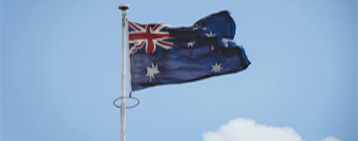
• Australia 's national flag consists of a blue background with a “Union Jack” ( UK flag) in the upper left hand quarter; a large seven point star is positioned under the Union Jack and accompanied by five small starts on the right hand side.
• The Union Jack on Australia 's national flag is symbolic of the countries historical ties to Britain .
• The large star on Australia 's national flag depicts one point for each of the six original states and one representing all of the countries internal and external territories.
• The small stars on Australia 's national flag form the “Southern Cross” constellation which is a prominent feature of the southern hemisphere night sky.
• The Australian Government's official emblem - or coat of arms – was granted by King George in 1912 and consists of a shield containing the badges of the six States. On either side of the shield is a kangaroo and an emu. A yellow-flowered native plant, 'wattle', also appears in the design.
• Wattle is Australia 's national floral emblem.
• The koala – one of Australia 's most well known animals - is not a bear but a marsupial.
• Australia 's national colours are Green and Gold - taken from the colours of Australia 's floral emblem the Golden Wattle
• Australia follows a decimal currency which was introduced in 1966. The currency is made up of 5, 10, 20 and 50 cent coins, 1 and 2 dollar coins and polymer notes of $5, $10, $20, $50 and $100.
• Australia is a secular state and has no official religion.
• The Australian Education System is divided into five main groups: preschool; primary; secondary; career and vocational training; and university and tertiary institutions.
• Schooling is compulsory in most states and territories until the age of 15.
• The Australian Government provides help with medical expenses through a scheme called Medicare .
• Medicare provides health care services and programs such as free public hospital care, help with the cost of out-of-hospital care, and subsidised medicines.
• Wages and working conditions are regulated by the Workplace Relations Act 1996 and federal or state awards which set out minimum entitlements of employment such as wages, allowances, overtime, hours of work and leave entitlements.
• There are three time zones within the Australian continent.
• Australian cars are right-hand drive and they travel on the left side of the road.
• Australian electricity voltage for domestic use is 220-240 volts, AC 50Hz with 3-pin power outlets.
• Smoking is banned on public transport, in many offices and public buildings, cinemas and theatres
• Australia operates on the metric system of measurement.
TRANSPORTATION
Australia’s Public Transport system comprising of Trains; Buses; Trams and Taxis is very efficient and connects to almost all suburbs in a Metropolitan City. Public transport is initially used by new migrants but it is advisable to have the experience of driving a car, as it is the most convenient/economical way of transportation for the family. Trains and buses are normally used to commute to one’s work place.
EDUCATION
The Education System in Australia comprises of:
a) Primary and Secondary Schooling
b) Technical and Further Education (TAFE) - Various Vocations
c) University Education
A new migrant can enroll their children in any one of the above, after arrival. There are basically 2 categories of schools – Public (which is Government funded) and Private Schools. The curriculum and period (12 years of studying) is generally common among both categories. Education in schools is holististic preparing a child to go out into the world with confidence.
There are many TAFE Institutes that cater to students who wish to make a career in various vocations.
Australia has some of the world’s prestigious Universities and the costs are affordable.
TYPES OF VISAS FOR AUSTRALIA
Our area of expertise covers the following categories:
- Skilled Independent Visa
- Family Sponsorship Visa
- State/Territory Sponsorship Visa
- Spouse Visa
- Parent Visa
- Tourist Visa
- Business Visa
- Investors Visa
- Dependent visa
- Handling refusal visas
- Visitor visas
- Students visas
![]() |
IMMIGRATION POLICIES
The extent to which any country allows immigration depends on how much that country needs to attract new citizens. Australia requires immigrants. Immigration to Australia is now based on a quota system so that the number of immigrants from any particular occupation is restricted. Skilled persons can apply for immigration under 4 categories viz.:
1) Independent - one who does not need a sponsor
2) Skilled – Family sponsorship - one who is sponsored by a blood relative, who is a citizen or Permanent Resident of Australia
3) State Sponsorship – one who is sponsored by a State
4) Employee Nomination Scheme (ENS) – one who is sponsored by an Employer.
There are changes to the Immigration Policy from time to time to regulate the intake and meet the quota system. Immigrants qualify according to preferences, often calculated on a points system. Points are awarded for job skills, age, education, language ability and personal factors.
The Points Test
Who can qualify is determined by a "Points Test", where points are awarded on various factors such as Employability and Level of Skill, Education, Years of Experience, Proficiency in English and Sponsorship (for those who are sponsored by close blood relatives). The points test is a scale which is used by the Visa Officer to determine whether an applicant qualifies for migration or not.
It is important to note that the 'points test' undergoes changes from time to time and one has to study well, one's chances of qualifying and should lodge an application when the situation is favourable. A formal Assessment is mandatory, prior to lodging an application.
QUALIFYING CRETERIA FOR SKILLED WORKERS & PROFESSIONALS VISA:
The basic requirements are:
AGE : 18- 44yrs
ENGLISH language proficiency: IELTS
BECOMING A CITIZEN

The legal process by which a person acquires citizenship in a new country is called naturalization. Each country has its own rules, but, generally, a person who wishes to be naturalized must have been resident there for a specified number of years. Immigrants take an oath of allegiance to their new country and may have to give up citizenship of their country of origin. India allows its citizens to hold Dual Citizenship with Australia by way of an OCI (Overseas Citizen of India) card.
FAQ’S
WHY DOES AUSTRALIA REQUIRE IMMIGRANTS?
Australia is a young and dynamic country where immigration is the foundation for economic growth. Australia invites immigrants between the ages of 18 and 44 as there is a growing demand for skilled personnel (Professionals/Trades persons) to join the work force. Since they are unable to meet this requirement within their country, the Government has promulgated a policy which allows the citizens of the world to settle permanently and partake of the economic growth and prosperity of their country.
WHAT IS A PERMANENT RESIDENT VISA AND IT’S ENTITLEMENTS ?
WHAT ARE THE CURRENT PROSPECTS FOR EMPLOYMENT ?
As mentioned earlier, there is a growing demand for skilled personnel. One has to obtain the required points in the Skills/Employability criteria, apart from other factors as mentioned in the foregoing. Having satisfied the visa officer that one is highly skilled in his respective field and gained the required points to qualify, the application will proceed to a grant of visa. Therefore, when a prospective migrant arrives into the country, he/she is entitled to join the work force immediately. Registration or licensing may be required in some instances.
It must be understood that, the Australian Government has taken into consideration the basic needs of a new immigrant, and has an infrastructure to welcome and accommodate such persons, who can approach employment agencies, which will assist them in seeking employment suitable to their qualifications. Private Employment Agencies and Internet browsing could be other avenues used to seek employment.
Australia’s average job vacancies are above 170,000 per annum and one can gain employment in the private and public sector. Skilled migrants who comprise of professionals and tradesmen could gain employment within a reasonable period of time after migrating. The Permanent Resident Visa entitles a migrant to work as soon as he arrives in Australia.
It is advisable to apply for a Tax File Number (TFN) and open a Bank account before one starts looking for employment.